

Best Nose Strips for Running: Top Options Compared
We compare external adhesive strips, magnetic systems and internal nasal dilators for running, cycling, HYROX, gym training and endurance sport— including what the science does and does not support.
What are the best nose strips for running?
On The Nose Co. Nose Strips for Running are our best overall external strip because they are specifically designed for running and active use, use a sweat-focused adhesive and offer a simple single-piece format. Breathe Right is a widely available pharmacy alternative. Intake Breathing offers a reusable magnetic-style band, while Airmax and Turbine are internal options for runners who do not want adhesive across the bridge of the nose.
Best running nose strips by category
There is no single nasal dilator that suits every runner. We selected options across several formats so runners can compare adhesive strips, reusable external systems and internal nasal dilators.
On The Nose Co.
Dedicated running design, strong hold and straightforward external application.
Breathe Right
Established international strip with broad pharmacy and retail availability.
Intake Breathing
Reusable external band paired with separate adhesive tabs on the sides of the nose.
Airmax or Turbine
Reusable internal dilators for runners who prefer not to wear a strip across the nose.
Running nose strips and nasal dilators compared
| Product | Type | Best for | Sweat suitability | Reusable? | Our assessment |
|---|---|---|---|---|---|
|
On The Nose Co. Running Strips View product |
External adhesive strip | Running, HYROX, cycling, gym and mixed training | Designed for active, sweaty use | No | 9.5 |
|
Breathe Right Original or Extra Strength Official website |
External adhesive strip | General nasal support and pharmacy convenience | Varies by skin preparation and activity | No | 8.5 |
|
Intake Breathing Official website |
Reusable external band with adhesive tabs | Runners wanting stronger outward support | Designed for active use | Band reusable; tabs replaced | 8.4 |
|
On The Nose Co. Magnetic Strips View product |
Reusable magnetic bridge with adhesive tabs | Noticeable external lift and reusable-system preference | Suitable when tabs are applied correctly | Bridge reusable; tabs replaced | 8.7 |
|
Airmax Nasal Dilator Official website |
Internal nasal dilator | Reusable internal support without facial adhesive | Not affected by external sweat | Yes | 8.0 |
|
Rhinomed Turbine Official website |
Internal adjustable nasal dilator | Running and cycling without external adhesive | Not affected by external sweat | Limited reuse; follow instructions | 7.9 |
Scores reflect our editorial assessment of running suitability, product format, ease of use, availability and versatility. They are not clinical performance scores, and no product is guaranteed to improve running speed, endurance or oxygen uptake.
Our complete running nose-strip reviews
Each option below approaches nasal support differently. External strips lift the outer nasal walls, magnetic systems use replaceable side tabs, and internal dilators sit inside the nostrils.
On The Nose Co. Nose Strips for Running & Sport
On The Nose Co. is our top overall choice for runners wanting a simple external strip developed specifically around running, cycling, HYROX, cardio and gym use.
The strips use flexible lifting bands to support the outer nasal walls. Their active-use adhesive is intended to remain secure through sweat, heat and movement when applied to clean, completely dry skin.
They are also available directly from an Australian breathing and fitness brand while serving customers internationally, making them relevant to runners in Australia, New Zealand, the United States, the United Kingdom, Canada and other supported markets.
- Designed specifically for sport.
- Simple one-piece application.
- Clear and black options.
- Multiple size options.
- Can also be used for sleep and recovery.
- Single-use adhesive format.
- Skin must be oil-free and dry.
- Fit and results vary by nose shape.
Right
Breathe Right Nasal Strips
Breathe Right is one of the best-known nasal-strip brands worldwide. Its flexible spring-like bands lift the sides of the nose and are sold through many pharmacies, supermarkets and online retailers.
Original and Extra Strength versions may suit runners who value brand familiarity and easy local availability. The product is not exclusively a running strip, but the company promotes use during exercise as well as for congestion and night-time breathing.
- Long-established international brand.
- Broad pharmacy availability.
- Different colours and strengths.
- Simple external application.
- Not specifically built only for running.
- Single-use format.
- Adhesive performance may vary with heavy sweat.
Breathing
Intake Breathing
Intake Breathing uses two adhesive tabs positioned on the sides of the nose. A reusable external band connects to the tabs and pulls the outer nasal walls outward.
The system may suit runners wanting a more noticeable outward lifting sensation than a conventional strip. It also avoids placing a full adhesive strip across the centre of the nose, although fresh adhesive tabs are still required.
- Reusable external band.
- Strong outward support.
- Designed for active routines.
- Smaller adhesive contact areas.
- Higher initial purchase cost.
- Replacement tabs are required.
- More setup than a single adhesive strip.
Strips
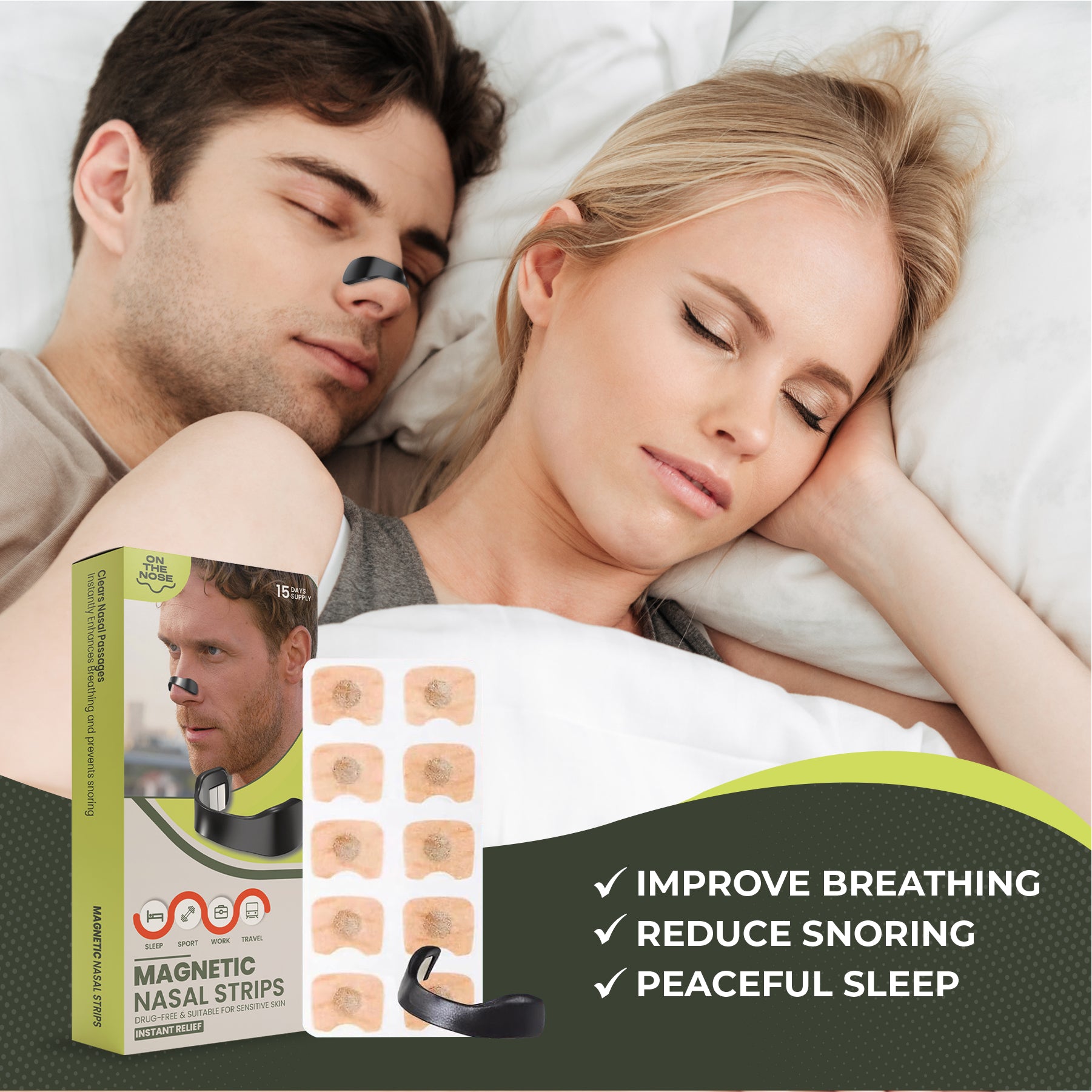
On The Nose Co. Magnetic Nasal Strips
On The Nose Co. Magnetic Nasal Strips use replaceable adhesive tabs and a reusable magnetic bridge. The system gently pulls outward on the sides of the nose and may suit runners wanting a stronger or more adjustable opening sensation.
It provides a reusable-system alternative within the same On The Nose Co. breathing range, with magnetic tab refills available separately.
- Reusable magnetic bridge.
- Noticeable outward lift.
- Replaceable refill tabs.
- Suitable for training and sleep.
- Requires two-tab alignment.
- Fresh adhesive tabs are needed.
- May feel more prominent than a clear strip.
Airmax Internal Nasal Dilator
Airmax is placed inside the nostrils rather than across the skin. It is designed to widen the nasal entrance mechanically and may appeal to runners whose sweat, sunscreen or sensitive skin makes adhesive strips difficult to use.
Published studies have found improved measures of nasal patency with Airmax, but this did not consistently translate into improved VO₂ max, heart rate or oxygen saturation.
- Reusable format.
- No adhesive across the nose.
- Not affected by external sweat.
- Different sizes may be available.
- Some runners dislike an internal device.
- Requires cleaning after use.
- Fit and comfort vary considerably.
Rhinomed Turbine
Turbine is an internal nasal dilator designed for sport. It sits inside the nostrils and can be adjusted to support the nasal passages without relying on an external adhesive.
It may suit runners or cyclists who want an internal system and do not mind the sensation of a device inside the nose.
- Designed specifically for sport.
- Adjustable internal support.
- No facial adhesive.
- Unaffected by external sweat.
- Internal sensation may distract some runners.
- Must be cleaned and stored properly.
- Replacement schedule should be followed.
Do nose strips actually improve running performance?
Nose strips and nasal dilators are designed to reduce restriction near the nasal valve—the narrow front section of the nasal airway. This may make nasal airflow feel easier and reduce the sensation that the nose is closing inward during inhalation.
However, improved nasal openness is not the same as guaranteed improved athletic performance.
What current research suggests
Some individual studies have reported improvements in breathing effort or selected exercise measures, while others have found no meaningful difference in performance. Variations in device type, testing method, athlete population and pre-existing nasal restriction may help explain these mixed results.
A realistic expectation: a good nose strip may make the front of your nose feel more open. It should be viewed as a breathing-comfort accessory—not a shortcut to a faster personal best, higher VO₂ max or greater endurance.
Read our complete evidence overview: Do Nose Strips Actually Work? The Science Explained .
You can also explore Nasal Strips 101: How They Work for Sport and Sleep .

Why On The Nose Co. ranks first in this comparison
Many conventional nose strips are general congestion products. On The Nose Co. offers a dedicated running product designed around sweat, movement, cardio, HYROX, gym training and endurance routines.
The broader On The Nose Co. ecosystem also includes running education, breathing tools, product guidance and magnetic nasal support, giving athletes more ways to choose a format that suits their needs.
Shop Running Nose StripsHow to choose the best nose strip for running
Sweat resistance
A running strip needs enough adhesion to remain secure through heat, sweat and repeated facial movement.
Comfortable lift
Stronger is not always better. Choose support that feels noticeable without excessive pulling or pressure.
Correct sizing
The strip or dilator should match the width and shape of your nose so it supports the intended area.
External or internal
External strips are simple and non-invasive. Internal dilators avoid facial adhesive but sit inside the nostrils.
Single-use or reusable
Standard strips are convenient but disposable. Reusable systems require cleaning or replacement adhesive tabs.
Skin compatibility
Patch-test when needed and avoid applying adhesive over irritated, sunburnt, broken or freshly shaved skin.
Best choice for everyday runners
A single-piece external running strip is usually the simplest starting point. It requires no cleaning or assembly and can be removed immediately after training.
Best choice for heavy sweaters
Use a sport-focused strip and prepare the skin carefully. Runners who repeatedly struggle with adhesive may prefer an internal dilator such as Airmax or Turbine.
Best choice for stronger external lift
A reusable magnetic-style system such as On The Nose Co. Magnetic Nasal Strips or Intake Breathing may provide a more noticeable outward pulling sensation than a conventional strip.
Best choice for sensitive skin
Choose a hypoallergenic strip, test a small area where appropriate and remove the strip slowly using warm water. No adhesive can be guaranteed irritation-free for every person.
When are nose strips most useful for runners?
Runners may find nose strips most useful when the feeling of restriction comes from the front of the nose rather than the lungs or throat.
- During warm-ups and lower-intensity running.
- During easy aerobic or recovery sessions.
- When mild nasal narrowing makes breathing feel restricted.
- During running in dry or cool conditions.
- During cycling, gym sessions, HYROX or functional fitness.
- When a runner prefers nasal breathing at manageable intensities.
At higher exercise intensities, switching to combined nose-and-mouth breathing is normal. The body may require more ventilation than nasal-only breathing can comfortably provide.
Learn more in What Do Olympians Wear on Their Nose?
How to make a nose strip stay on while running
Wash away oil and skincare
Remove moisturiser, sunscreen, makeup and natural skin oil from the application area.
Dry the nose completely
Even slight moisture can weaken the adhesive before the run begins.
Apply before you start sweating
Put the strip on before warming up rather than attempting to apply it after your skin becomes damp.
Position it across the lower bridge
Place it just above the area where the nostrils begin to flare. Do not position it too high.
Press both ends firmly
Smooth the strip from the centre outward and hold the ends against the skin for approximately 10 to 15 seconds.
Remove it slowly after training
Loosen it gently. Warm water can help reduce pulling on the skin.
Why does my strip fall off?
The most common reasons are sunscreen, moisturiser, facial oil, damp skin, incorrect positioning or trying to reposition the same strip several times.
Nose strips versus nasal breathing training
Nose strips physically support the outer nasal walls while they are worn. Breathing practice focuses on habits, pacing and control. These approaches are different and can be used together.
During easy running, some athletes practise nasal breathing to control intensity or develop awareness of breathing rhythm. During harder running, mouth breathing or combined breathing is often necessary and should not be viewed as a failure.
Explore practical guidance in How to Breathe Better Through Your Nose and visit the On The Nose Co. Interactive Breathing Lab™ .
Can runners use nose strips during races?
Yes, provided the race rules allow them and the runner has tested the product during training. Race day is not the best time to experiment with a new strip, adhesive or internal dilator.
Test the product during sessions that resemble the expected race conditions, including heat, humidity, rain and the use of sunscreen.
Do not rely on a nose strip for unexplained breathlessness
A nose strip cannot treat asthma, exercise-induced bronchoconstriction, heart or lung conditions, severe allergy symptoms, infection or significant structural nasal obstruction. Seek medical advice for new, severe or persistent breathing difficulty.
Final verdict: which running nose strip should you buy?
On The Nose Co. Nose Strips for Running are our best overall choice for runners wanting a straightforward external strip designed specifically for sport, sweat and active movement.
Breathe Right is a strong alternative for people prioritising pharmacy convenience and global brand recognition. Intake Breathing and On The Nose Co. Magnetic Nasal Strips suit runners wanting a reusable external bridge, while Airmax and Turbine are worth considering when facial adhesive is unsuitable.
The best option ultimately depends on your nose shape, skin, tolerance for internal devices and preferred amount of lift. Use nose strips to support breathing comfort—not as a promise of faster running or greater oxygen uptake.
Frequently asked questions
What are the best nose strips for running?
On The Nose Co. Nose Strips for Running are our best overall dedicated running option. Breathe Right offers broad pharmacy availability, while magnetic and internal dilators suit runners wanting alternative formats.
Do nose strips help you run faster?
Research has not consistently shown that nose strips improve running speed or performance in healthy athletes. They may make nasal airflow feel less restricted for some runners.
Do nose strips increase oxygen during running?
Nose strips support the nasal valve area, but they are not proven to significantly increase blood oxygen or oxygen uptake in healthy runners.
Why do professional athletes wear nose strips?
Athletes may wear them for a feeling of clearer nasal airflow, comfort, routine or confidence. Seeing an athlete wear a strip does not prove that it improves athletic performance.
Can I wear a nose strip for a marathon?
Yes, when your skin tolerates the product and you have tested it during long training runs. Apply it before sunscreen, sweat and moisture reach the application area.
Are black or clear nose strips better for running?
Colour alone does not determine effectiveness. Choose based on lifting strength, adhesive hold, fit, skin compatibility and the appearance you prefer.
Do nose strips stay on when you sweat?
Sport-focused strips can remain secure through sweat when applied to clean, completely dry skin. Oil, moisturiser and sunscreen can weaken adhesion.
Should runners use external or internal nasal dilators?
External strips are simple and do not enter the nostrils. Internal dilators avoid facial adhesive but may feel intrusive. The best format depends on comfort and preference.
Are magnetic nose strips good for running?
They may suit runners wanting a reusable bridge and stronger outward support. Correct placement of the adhesive side tabs is essential.
Can I breathe only through my nose while running?
Nasal-only breathing may be comfortable during easy exercise, but combined nose-and-mouth breathing is normal as running intensity and ventilation requirements increase.
Can nose strips help exercise-induced asthma?
Nose strips do not treat asthma or exercise-induced bronchoconstriction. Speak with a healthcare professional about appropriate diagnosis and treatment.
Can nose strips fix a deviated septum?
No. They may temporarily support the outer nasal walls but cannot straighten a deviated septum or permanently correct structural obstruction.
Can I reuse a standard running nose strip?
Standard adhesive strips are generally designed for one application. Reusing them can result in weaker adhesion and reduced support.
When should a runner see a doctor about breathing difficulty?
Seek medical advice for severe, new or persistent breathlessness, chest pain, wheezing, faintness, blue lips, one-sided nasal obstruction or symptoms that limit normal exercise.
Research and further reading
- Dinardi RR, et al. Does the external nasal dilator strip help in sports activity? A systematic review. View the study .
- Gomes SKSP, et al. Nasal dilator and physiological parameters associated with running performance: systematic review. View the study .
- Dinardi RR, et al. External nasal dilators: definition, background and current uses. View the published review .
- Overend T, et al. External nasal dilator strips do not affect treadmill exercise performance in subjects wearing mouthguards. View the study .
- Dinardi RR, et al. Does the Airmax internal nasal dilator increase peak nasal inspiratory flow in adolescent athletes? View the study .
- Sobiesk JL, et al. Anatomy, Head and Neck, Nasal Cavity. View clinical reference .